
Trump’s travel ban has revoked 60,000 visas for now
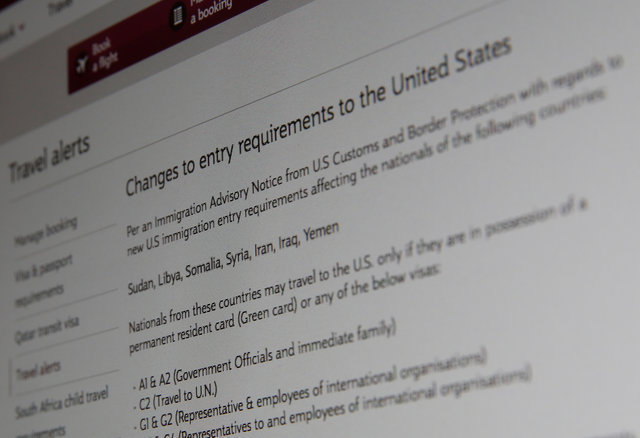 A picture of the travel advisory page of Qatar Airways advising passengers bound for the United States from seven newly banned majority Muslim countries that they need to have either a US green card or diplomatic visa, January 28, 2017 in London, Britain. (Photo: Reuters)
 About 60,000 visas were revoked under US President Donald Trump’s executive order temporarily halting immigration from seven Muslim-majority countries, the State Department has said, in one of several government communications clarifying how the order is being rolled out.
The revocation means the government voided travel visas for people trying to enter the United States but the visas could be restored later without a new application, said William Cocks, a spokesman for consular affairs at the State Department.
“We will communicate updates to affected travelers following the 90-day review,” he said.
Earlier news reports, citing a government attorney at a federal court hearing, put the figure at more than 100,000 visas.
The government issued over 11 million immigrant and non-immigrant visas in fiscal year 2015, the State Department said.
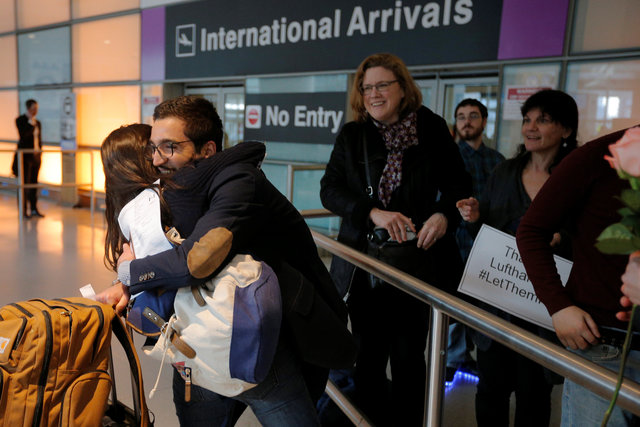
Behnam Partopour, a Worcester Polytechnic Institute (WPI) student from Iran, is greeted by his sister Bahar (L) at Logan Airport after he cleared US customs and immigration on an F1 student visa in Boston, Massachusetts, US, February 3, 2017. Partopour was originally turned away from a flight to the US following US President Donald Trump’s executive order travel ban. (Photo: Reuters)
The immigration executive order signed by Trump a week ago temporarily halted the US refugee program and imposed a 90-day suspension on people traveling from Iran, Iraq, Libya, Somalia, Sudan, Syria and Yemen. Trump said the measures would help protect Americans from terrorist attacks.
Under President Barack Obama, Trump’s predecessor, the United States added those seven countries as “countries of concern” under its visa waiver program, effectively toughening US visa procedures for individuals who visited those places during the past five years.
Trump’s executive order was at least in part informed by those restrictions. The new president, who took office on January 20, went further by temporarily barring passport holders from those seven countries.
The State Department first issued the guidance about revoking the visas on January 27, the day Trump signed his executive order, according to a memo filed in a court case in Massachusetts.
But confusion about the roll out of the order sparked protests at airports across the country where people had been detained and led to a wave of lawsuits filed by individuals, states and civil rights groups.
To further clarify how the order should be applied, the US Citizenship and Immigration Services (USCIS) sent out a letter to all of its employees on February 2, according to a copy of the memo seen by Reuters.
The memo said the agency was continuing to process all applications and petitions for people inside the United States regardless of their country of origin. It also said all applications for permanent residency and adjustment of status can move forward.
USCIS said they could not discuss internal employee communications.
The Department of Homeland Security had earlier clarified, after some initial back-and-forth, that the order would not apply to green card holders. Also people from the seven countries who hold dual citizenship are allowed to enter the United States on the passport of a non-restricted nation when eligible, according to February 2 guidance posted by US Customs and Border Protection’s website.
– Reuters